"olive green dress" - Google News
[unable to retrieve full-text content] Hot olive green dress wedding guest Cheap Sale Olive Green Dress Silk Dress Wrap Dress Bridesmaid Dress Through The Fence Baseball
A bride tried on 6 dresses before finding the one, but then she had to postpone her wedding - Insider - INSIDER |
| Posted: 13 Apr 2020 12:06 PM PDT
Sabina Leybold and Harsh Bhargav didn't expect to like each other.Leybold, 23, and Bhargav, 24, met on a dating app in Philadelphia, Pennsylvania, early in 2019. "Neither of us was super excited about the first date," Leybold told Insider. But they decided to meet up anyway, and they were surprised to find themselves quickly enamored with one another. They ended up seeing each other three more times that week. "We've basically been inseparable ever since," Leybold said.
The couple got engaged in January 2020.The proposal didn't come as a surprise, as Leybold and Bhargav had already talked about getting married in March 2020. "We picked our venue the day before he proposed," Leybold said. "We're both pretty low-maintenance," she added. "Neither of us wanted a big, huge wedding." The couple planned a small wedding of around thirty guests for March, with Bhargavr's family, who are based in India, planning to fly to the US for the nuptials.
Leybold started looking for a wedding dress a week after she got engaged.Since the wedding would take place only two months after the proposal, she didn't have much time to shop. Leybold planned on wearing a white cocktail dress rather than a wedding gown, as she thought it would go better with her laid-back vibe. "I wanted something that was comfortable," she said of her vision for a dress. "That was my number one priority while shopping. One that felt comfortable and let me move around." That immediately ruled out a strapless dress for Leybold, as the style didn't sound comfortable to her.
Leybold also knew she wanted her dress to coordinate with the sherwani Bhargav would wear.Bhargav wanted to honor his Indian culture with his wedding ensemble, so he planned to wear a traditional sherwani to the wedding. "I chose not to also wear something Indian," Leybold said. "It's not my background, and it wasn't necessarily something that I saw myself in." "I still wanted to have more of an American-style wedding dress, but I wanted to have something that would look good with what he was wearing." With that in mind, Leybold started shopping for dresses online with a loose budget of $500.
The second gown was supposed to be a white midi dress, but Leybold's height made it shorter than she anticipated.The $198 Dress The Population gown had a cinched waist and sweetheart neckline, and when Leybold saw it online, she loved the mid-calf length it was supposed to have. Leybold said she thought it was "the dress" when she first saw it on the website. "But on the model in the picture, it was midi-length, and I'm so tall that it's a knee-length dress." "I liked it. It just wasn't what I was expecting," she said. The search continued.
Leybold thought this gown was pretty, but it wasn't as comfortable as she was hoping it would be.The $271 Dessy Collection gown was the most formal of the dresses she ordered. While Leybold liked the straight silhouette it created, the off-the-shoulder straps prevented her from lifting her arms, which wouldn't work for her wedding. "I couldn't move my arms, so that wasn't going to happen," she said. After trying on the more casual dresses at home, Leybold realized she did want a more formal wedding gown. "You can wear a white dress any old day, but something as formal as a bridal gown is meant to at least be a once-in-a-lifetime thing," she told Insider.
So Leybold headed to a bridal shop with one friend to try on dresses.She went to The Sample Rack in Philadelphia, which only has sample dresses. The gowns can't be custom ordered, and there's often only one of each gown in a size in the store, so it's important to buy a dress you like quickly. "They are on the lower end price-wise, but are still a higher-end type dress," Leybold said of the dresses in the store. Leybold tried on this A-line gown first, drawn to the tiered lace design on the skirt. Although it was pretty, she didn't love the dress. "I don't know what it was about it," she said. "It just didn't really feel right. I think I was uncomfortable in it."
Leybold was surprised to find herself drawn to this princess-style ball gown."I was surprised that I liked it," Leybold said of the ball gown, which had beaded detailing on the bodice and a tulle skirt. "It does feel very American princess wedding, not this 'mishmash of cultures' vibe" that she was hoping to find in a gown, Leybold explained. "And it was going to need a lot more alterations," she added. "It was too small, so the back would need to be entirely redone." Leybold said that sounded risky and like it would cost a lot of money. "It didn't have the right feeling, and I also wasn't emotionally attached to it. I wasn't going to be emotionally upset if that dress was gone," Leybold said.
But when she tried on this fitted gown, Leybold knew she found something special.The fitted Willowby By Watters dress had a V-shaped neckline and geometric crochet detailing throughout the gown. Leybold loved the pattern detailing on the gown in particular. It "felt like it could toe the line" between Leybold and Bhargav's cultures, as she put it. The dress was approximately $1,200, which was more than double Leybold's original $500 budget. "Besides our photographer, my dress is the most expensive thing happening at our wedding," Leybold said.
The gown also had a dynamic shape on the back that Leybold was drawn to.She was torn between this gown and the princess-style dress, so she wanted to sleep on her decision. But then Leybold's shopping companion asked her how she would feel if someone else bought the gown, preventing her from getting it since there was only one version of the dress in her size at the store. She realized she'd be devastated if the dress was gone, so she decided to buy it that day.
The gown needed a few alterations after Leybold bought it.Because the dress was a sample, it didn't fit Leybold exactly right when she bought it. First, it needed to be taken in and the straps needed to be shortened. "It probably would've been better if it was down a size, but luckily that's a pretty easy alteration to make," Leybold said. But the biggest alteration was removing the gown's train, which pained Leybold to do. "Our venue is very small, we're only having thirty people, and comfort is so important to me, so I don't want to have a train," she said. "I'm going to be tripping over it all night or I'd have to carry it around, or someone else is going to step on it because our venue is so small." "It was too bad because I really thought it was beautiful. I was distraught," she added.
As the March wedding date approached, Leybold and Bhargav realized they wouldn't be able to have their event as planned because of the coronavirus.They realized it was time to postpone on March 15. Both of their companies implemented work-from-home policies, and travel restrictions were starting to be put in place, which was a problem because Bhargav's family planned on flying to Pennsylvania from India. They postponed the wedding to October, though they planned to get married at home in the spring of 2020 anyway, thanks to Pennsylvania's self-uniting wedding option, which allowed the couple to get married without an officiant. "It's nice that we had the power to do whatever felt right for our relationship," Leybold said.
A few days after they postponed the wedding, Bhargav got the idea to have a photo shoot in their wedding attire before the couple had to self-isolate."I think we were both mourning the loss of the celebration," Leybold said. "We knew it was the right decision, but it was a sad decision." Bhargav suggested they see if their photographer could spend an hour or two with them from a distance before they had to totally self-isolate. They hoped it would make the postponement a little less upsetting.
"I would have never thought to do that," Leybold said of the photo shoot."I'm really glad he suggested it because it was an extra special day," Leybold said of her now-husband's idea. The day was also fun because Leybold had a pre-existing relationship with their photographer, Amanda Swiger, as she had previously done a boudoir shoot with her. "She's hilarious," Leybold said of her photographer.
The couple had a blast taking pictures together."Amanda was just like, 'Sometimes I have couples who don't really want to be affectionate on camera or grooms who aren't really into it,'" Leybold said. But Bhargav was just as excited to be there as his soon-to-be wife, and he had no trouble showing his love for Leybold.
Leybold said the shoot was more fun because it felt a bit like the last hurrah."Knowing that we were going to be isolated for a few weeks, you know?" she added. "It was a beautiful day in Philly, and there was just this resounding feeling of we're all doing our best right now." "It was just like the embodiment of that for sure," she said.  |
| After the Pandemic, the Office Dress Code Should Never Come Back - The Atlantic Posted: 13 Apr 2020 07:18 AM PDT 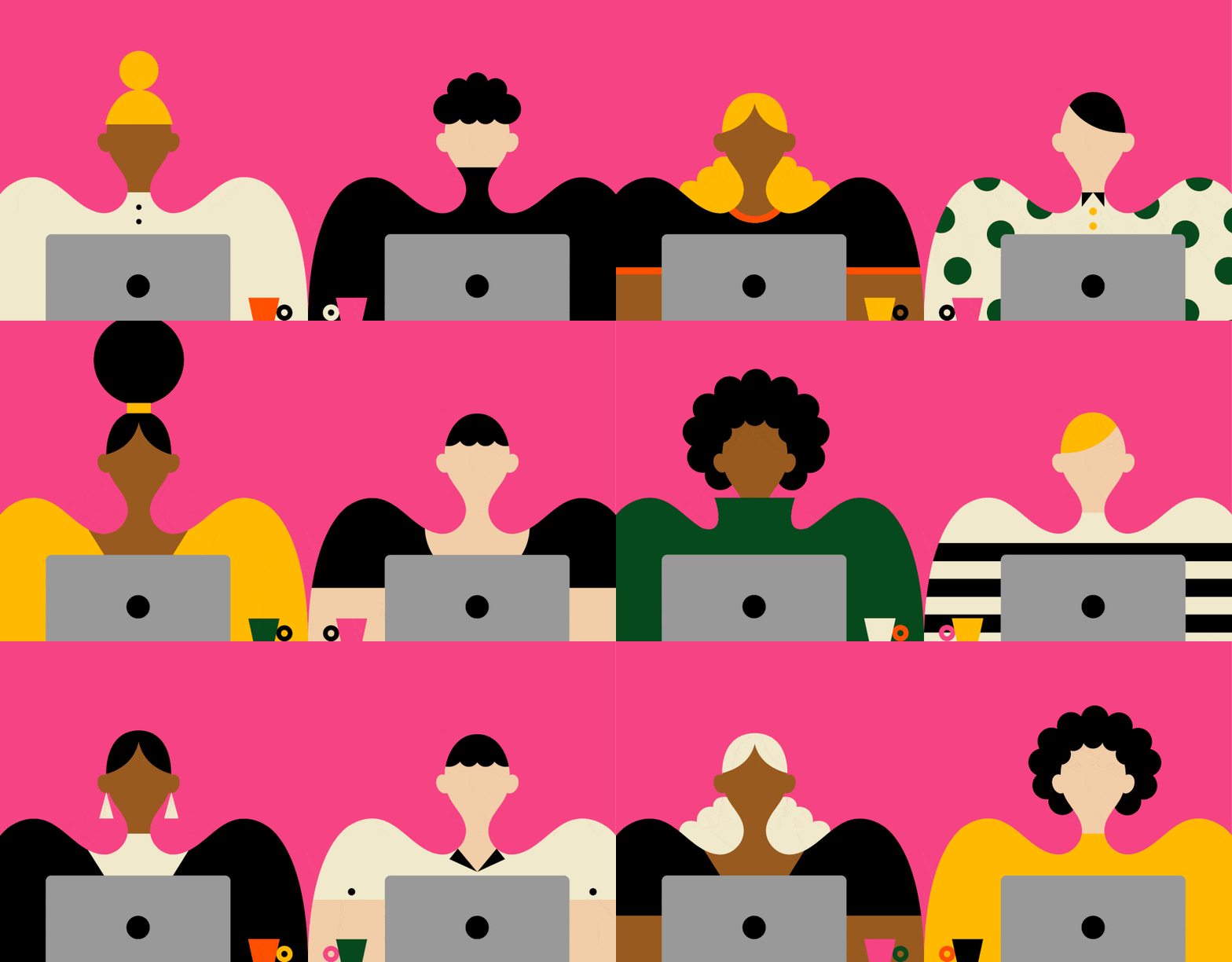 Being online has many rules. Some of the more exciting or distressing ones have names—Godwin's Law, about the inevitability of someone invoking Hitler during an internet argument; Rule 34, which guarantees the thematic completeness of the web's pornography. But mostly, the internet's rules are just de facto guidelines for what to expect in this or that circumstance—observations rather than codifications. Among the most reliable and least frequently noted of these is that wherever people gather to chat about anything, the conversation will eventually turn to the problem of what to wear to work. In subreddits dedicated to accounting, engineering, and New York City, people ask to see others' work outfits or for descriptions of their employee dress code. In Facebook groups about weight loss or motherhood, inquiries abound on where to get an inexpensive black blazer, and who makes the best office-appropriate cropped pants. On Hacker News, a message board for Silicon Valley tech workers, a man in his late 30s recalled being humiliated by the CEO at his new job for daring to wear a button-down shirt among his cargo-shorts-clad co-workers. On Yahoo Answers, the world's least qualified people have been meting out bad advice on twinsets and shin-length skirts to confused 23-year-olds since 2005. In theory, the question of what to wear to work shouldn't pose an unanswerable dilemma. Most workplaces have at least some kind of dress code, and for many of those who greet customers and perform service jobs, a specific uniform is required. Even in the most ambiguous situations, context clues abound on the bodies of colleagues: If no one ever wears jeans, you probably shouldn't either. But the agita over how to groom yourself for work—hair straight or curly? cover your tattoos or live in the year of our Lord 2020? leggings as pants?—appears to afflict baristas, lawyers, cops, and the denizens of suburban office parks in roughly equal measure. Much of that confusion is the result of rapid change. Millennials, notorious murderers of American institutions and social norms, are now the largest generation in the country's workforce. As the oldest members of that group, people in their late 30s, accrue power in their organizations, they've started to reshape the meaning of "work clothes" in their image—upending the very idea of a dress code as a single standard to which all should aspire. When they're done, work clothes might be dead for good. Whether that future looks like a descent into midriff-baring anarchy or a sweet reprieve from the tyranny of binding waistbands probably depends on whether you're a person who makes rules or one who is subject to them. Read: Is it weird to wear leggings at work? In the American imagination, the standard for professional work wear has long been a suit or a conservatively tailored dress, even for workers who don't go into an office. That's largely held true despite the successful invasion of "business casual," jump-started by Dockers as a marketing gambit in 1992. That many of the world's most profitable companies—Google, Facebook, and Apple among them—allow employees to come to work in jeans and sweatshirts all week has yet to meaningfully destabilize that perception. With that in mind, at the beginning of every new term, Regan Gurung shows up to teach his psychology students at Oregon State University in a full suit and tie. Gurung is also taking a cue from his own work. According to two studies he conducted, women, at least, are rated by others as more competent when they wear formal attire. And we actually act as though dress influences our abilities: Subjects clad in white lab coats perform better on tests than those without them (though the experiments were conducted with undergrads who didn't wear lab coats regularly, so it's hard to tell how enduring the effect would be once the novelty fades). The gap between our internalized notions about professionalism and what a company's dress code says is why going to work in shorts still causes anxiety that pushes some people onto Reddit and Facebook with their skittish inquiries about what to wear. If a polo shirt is fine, wouldn't a button-down be even better? If everyone around you at a start-up is wearing ripped jeans, wouldn't a dress from Ann Taylor stand out in a good way? Is your company's dress code just a secret test of high-level reasoning skills designed by fiendish bosses? Read: The mystery of business casual The association between competence and traditional dress is so durable, in part, because for years mass media have told us that machers wear well-cut suits or prim sheath dresses in neutral tones. Had our first glimpses of Mad Men's Don Draper or Scandal's Olivia Pope caught them in cutoffs and a raggedy souvenir T-shirt from spring break, their world-beating dominance might not have been as evident. In a twist in the we-are-what-we-wear story, researchers at Harvard identified what they called the red-sneakers effect. It posits that as long as the person ignoring workplace guidelines is perceived to be doing it purposefully, evaluations of that person improve—think Mark Zuckerberg and his "fuck you" hoodies in early Facebook business meetings. After all, there's no greater power than being exempt from the rules that govern everyone else. For the people roaming the internet second-guessing how comfortable they can really get at work, Gurung has good news, in the form of another psychological bias—toward the persistence of first impressions. "If your first impression is a good one and shows you're taking the job seriously, the association between being dressed well and credibility and knowledge is strong enough that what you do later doesn't matter as much," he explains. As long as you don't draw too much attention to yourself by being bad at your job or making your co-workers miserable, you can safely start wearing that one sweater you love that's sort of like a fancy bathrobe. Most studies on clothing perception, after all, deal with snap judgments about strangers. Gurung's first-day suit? It's just for show. "Literally by week two, I no longer wear a jacket," he says. By the end of the term, he's tie-free, shirtsleeves rolled up. It's no secret that there's a rising premium on "being yourself, being an individual, bringing your full self to work, broader expression of who you are," says Scott Cawood, the CEO of WorldatWork, a global association for human-resources professionals. (WorldatWork, he notes, doesn't have a dress code.) He traces the codes' modern existence back to the Industrial Revolution, when standardized, indoor workplaces became the new normal. Before that, laborers were freer to dress in ways that suited their duties, often on family farms, and had smaller wardrobes to begin with. No one had to consider whether yoga pants were appropriate for gathering the day's eggs. As the norms we know now were developed, the people in power made them in accordance with their own preferences. "You traditionally had men in the C-suite, and they had certain conceptions of how men and women should look. That's why there was so much concern about can you wear skirts, can you wear pants," Cawood says. Some of those rules are still enforced in workplaces that prize formality—fine-dining establishments, white-shoe law firms, Congress—including guidelines about hosiery, makeup, and women's hairstyles. Doing away with these standards is a question not just of gender, but of class: The more comprehensive the expectations for presentation, the more resources required to meet them, and buying a closetful of work wear is a lot more expensive than just using what you already own. Read: Wearing a suit makes people think differently Racial bias, or at least blind spots, has also been embedded in dress codes, perhaps most notably in prohibitions on hairstyles popular among black people, such as braids and afros. "It's a lack of perspective or empathy," says Angela Hall, an associate professor at the Michigan State University School of Human Resources and Labor Relations—a thoughtlessness about what might make someone else's life more complicated. But of course, the impact can be far less benign: Employment law is riddled with cases like that of a black woman who in 2010 had a job offer rescinded because she refused to cut her dreadlocks; the company's dress code stipulated only that hairstyles be businesslike, professional, and not "excessive." Hall notes that changes to work itself have spurred a reconsideration of what constitutes "work clothes." On the day we spoke, schools in East Lansing were closed for a snowstorm, so she was working and parenting simultaneously. And the more that work leaves the office—an evolution that may well be accelerated by the coronavirus—the harder it becomes to associate work with a particular mode of dress. The growing pains of that process have already created an icon of the contemporary workplace, however aesthetically unfortunate: the Patagonia power vest. The seepage of work beyond the office is one of the defining experiences of modern employment—and from one perspective, the erasure of dress codes isn't helping. In the past, you could come home and take off your uniform or office attire with the knowledge that you were totally free until the next day, mentally and physically. Now many people wear the same jeans they wore to work to cook dinner, cellphone and laptop never too far from reach, the mind and body never totally disconnected from labor. Even the mass entertainments that have made the suit-and-tie look such an enduring shorthand for professionalism are beginning to fade, no doubt because the same young Americans who now constitute the majority of the broader labor pool have real influence in shaping what ends up on your screens. TV series such as Silicon Valley and Superstore depict occupational aesthetics as something closer to what they've been for millions of Americans for the past decade: people wearing the same clothes to their job that they'd wear to the movies or to lunch with a friend, sometimes complemented by a company-issued jacket or an ID-carrying lanyard. Gurung, Cawood, and Hall all agree that the mandate for greater fairness in the workplace—spurred by nondiscrimination laws and the need to retain workers in a tight labor market—will likely spell the end of the dress code as we know it, sooner rather than later. For traditionalists, this might sound like an abandonment of pride and professionalism, but in reality, Cawood says, companies that overhaul, simplify, or drop their dress code rarely do anything but make their employees happier. Regulating bad behavior—everything from being a smelly desk neighbor to sexual harassment—doesn't require rules about pantyhose or facial hair. Cawood points to General Motors as a model for policing how employees adorn themselves, even if it means managers actually have to manage. The entire dress code is two words: Dress appropriately. Ultimately, what such simple dictates acknowledge is that workers are adults, not babies at productivity day care. "People just generally know how to self-govern, and I don't think you need these archaic rules to punish that outlier that may or may not occur," Hall said. "Just cover the things you want covered and call it a day." This article appears in the May 2020 print edition with the headline "Kill the Office Dress Code." We want to hear what you think about this article. Submit a letter to the editor or write to letters@theatlantic.com.   Amanda Mull is a staff writer at The Atlantic.  |
| 22 Dreamy White Wedding Looks to Make Up for the Canceled Spring 2021 Bridal Shows - Vogue Posted: 13 Apr 2020 01:38 PM PDT .jpg) This week is typically when Vogue Runway editors attend runway shows and presentations all over the city to cover the new bridal collections. That isn't the case this season, of course: In light of the COVID-19 pandemic, Bridal Week was canceled, along with the resort 2021 shows in May, the menswear shows in June, and couture week in July. While those ready-to-wear collections will likely be viewed by editors and buyers remotely—perhaps with an assist from livestreams or virtual reality—bridal designers didn't have as much time to prepare. In mid-March, the Bridal Council announced that the spring 2021 bridal shows were "going digital" with Zoom videos and online galleries, but we've learned that many designers haven't had the time or finances to pull off those virtual experiences. Several of them haven't even finished making their gowns, since New York factories and studios were closed right in the middle of production. It's unclear how dramatically this will impact the spring 2021 collections, which brides would typically shop for and purchase later this year. (Bridal is shown a full year in advance to accommodate the made-to-measure schedule.) If some designers can't create a full line, they may be forced to skip this season; others are planning to show later this summer, albeit a few months "behind" the calendar. We'll be reporting on all of that later this week, but in the meantime, brides-to-be shouldn't be concerned about a lack of options to choose from—especially considering how many gorgeous white gowns we saw on the fall 2020 runways. Nearly every major show had at least one standout white dress this season, and in some cases, they were actually intended for weddings: At Richard Quinn and Simone Rocha, the models wore dramatic veils with their ivory frocks. Other examples were subtler, like Rodarte's puffed-sleeve gown with 3D petals. No, it wasn't technically a "wedding dress," but Kate and Laura Mulleavy likely wouldn't be surprised to see a bride wear it down the aisle. In fact, as soon as the model Sasha Knysh glided by in St. Bartholomew's Church, my colleague Brooke Bobb and I turned to each other and said in unison: "That's the perfect wedding dress." Whether the tag says "bridal" or "ready-to-wear" or "fall" or "spring" isn't really the point; in 2020, a wedding dress is whatever you want it to be. Perhaps that explains why designers are embracing white dresses in the first place. The bridal industry has been growing exponentially—in 2019, it was estimated to be nearly $300 billion—and there's a new demand for more modern, fashion-forward wedding options. The 2020 bride is increasingly willing to break with convention, whether it's by getting married on a farm or by wearing a jumpsuit instead of a ball gown. Perhaps she's also more interested in shopping with a designer she admires than walking into a typical bridal boutique—hence the significant business opportunity for ready-to-wear designers. We've pulled 22 of the most wedding-worthy white outfits from the fall 2020 runways. For women planning a wedding or getting engaged, they should spark a few new ideas. For the rest of us, they're a very welcome dreamy distraction.  |
| You are subscribed to email updates from "dresses online" - Google News. To stop receiving these emails, you may unsubscribe now. | Email delivery powered by Google |
| Google, 1600 Amphitheatre Parkway, Mountain View, CA 94043, United States | |


Comments
Post a Comment