"jeans near me" - Google News
[unable to retrieve full-text content] Obituary | Barbara Jean Shimp of Stephens City, Virginia Enders and Shirley Funeral Homes & Crematory
Womens Clothing Store Opening In March At Bethesda Row - Bethesda-Chevy Chase, MD Patch |
| Womens Clothing Store Opening In March At Bethesda Row - Bethesda-Chevy Chase, MD Patch Posted: 14 Jan 2020 03:14 PM PST  BETHESDA, MD — Johnny Was, a California-based women's fashion and lifestyle brand, is set to open its first Maryland location in Bethesda this March. Located at 4867 Bethesda Ave. — at the heart of Bethesda Row — Johnny Was will take over the space formerly occupied by Lilly Pulitzer, according to property owner Federal Realty Investment Trust. The 2,000-square-foot store will house the brand's signature embroideries, effortless silhouettes, Boho-inspired accessories, vibrant homewares, and sweet and balsamic fragrance line. "We are excited to expand our East Coast presence and open our first store in Maryland at Bethesda Row. We look forward to providing the ultimate shopping experience for our guests," Johnny Was CEO Rob Trauber said. Upon entering the store, customers will be greeted by floor-to-ceiling, nature-inspired murals, Italian tile floors, oak fixtures with bronze hardware, and a mix of custom and antique furniture. It appears to stay true to the vision Johnny Was set out to create. "With a bohemian spirit and a true sense of authenticity, we take our inspiration from anything that is beautiful, genuine and special — a striking piece of artwork, the luxurious hand-stitching on a vintage dress or the natural simplicity of a vibrant bougainvillea," according to the brand's website. Johnny Was will join a number of new restaurant and retail concepts in the neighborhood. "It's an exciting time at Bethesda Row," Federal Realty Investment Trust Senior Vice President of Leasing Stuart Biel said. "2020 will see the addition of new restaurants including Hawkers and The Riggsby, as well as first-to-market shops, including Serena & Lily and Heyday."  |
| Why girls need pockets - The Washington Post Posted: 15 Jan 2020 03:00 AM PST  The answer: Pockets, like most apparel, have a gendered history. The twist: It has only recently trickled down to most children's clothing — a development that has parents, including famous ones like Reese Witherspoon, as well as small retailers, using the Twitter hashtags #PocketsForGirls and #girlsdeservepockets, both of which have generated considerable buzz online. Lack of access to pockets is nothing new for the wealthy Western women held up as paragons of femininity. After all, they lost theirs over 200 years ago. But for much of history, working-class women, older women and girls had storage space in aprons, overalls and smock-like pinafores. That sartorial separateness evaporated in recent decades, with girls' clothing increasingly mirroring their pocketless mothers'. The lack of pockets not only restricts girls' ability to explore and discover, it also signals a limited view of what they can and ought to do. That should be unacceptable in 2020. To empower women, we're going to need to give girls their pockets back. But first, the backstory on "little bags," the rough translation of the Anglo-French poketes. Throughout much of the 18th century, women's pockets functioned like a travel money belt does today: as a sack attached to a string wrapped around one's waist and tucked under a layer of clothing. When voluminous skirts reigned in polite society before the French Revolution, pockets were hung between sets of petticoats, with slits cut through the top layer for access. One of the only private spaces available to women of the day, the bags safeguarded everything from needlework supplies and beauty products to snacks, snuffboxes and flasks — not to mention cash. But when the closer-fitting styles on display in any Jane Austen adaptation gained ascendancy in the 1790s, pockets couldn't be worn without creating bulges. Women were left with reticules, tiny over-the-arm purses. Once that happened, "If money bestowed the means for action and power, women's limited pockets … were ill-equipped for its enjoyment," writes historian Barbara Burman in the essay "Pocketing the Difference." Meanwhile, men enjoyed pockets sewn into their trousers, often tucking a hand inside one as an expression of "bodily confidence and presence," Burman writes. Of course, that wasn't a gesture allowed all men, nor is it today, reminds Clare Mullaney who, in the Atlantic, positioned the killings of Philando Castile and Tamir Rice as the most recent evidence of the social significance conveyed by "Who is allowed a pocket, and what can one carry [in it]?" Throughout the 20th century, women repeatedly reclaimed their pockets only to find them again sacrificed at the altar of the sleek lines that best track corporeal form. The April 1939 issue of Vogue made clear that style dictated rules for women's clothes. Female pants needed to be "well-cut and well-creased" — which meant smaller, often sewn-shut pockets, if any. (After all, a well-to-do woman could rely on her husband to carry things outside the home — or use a pocketbook, since there'd be no need to keep her hands free for opening doors or, gasp, working.) World War II, with its flock of women into the workplace, changed that. The group of women now iconified by Rosie the Riveter wore men's slacks with ample pockets, reported Ariana Tobin for Marketplace. But after the war, it was back to normal: Christian Dior made the message explicit in 1954: "Men have pockets to keep things in, women for decoration." The second-wave feminism of the 1960s and '70s produced more functional pockets for more women, but the increasing dominance of the "thin ideal" led designers to jettison women's pockets as impediments to a lean appearance. (Some argue designers also rationed pockets to sell more handbags.) While "girls' clothes for school or dressy occasions" tended to track these trends in the 20th century when it came to pockets, or the lack thereof, says Jo B. Paoletti, author of "Pink and Blue: Telling the Boys from the Girls in America," girls' informal clothing did not. As late as the 1980s, children's daily play clothes remained far less gendered than adult garb, as evidenced, according to Paoletti, by a 1964 Sears catalogue showing virtually identical pocketed pants for boys and girls. But in the past few decades, girls' clothing changed, becoming more feminine — almost cartoonishly so — with ruffles, frills and delicate fabrics, and like adult women's clothing, few or no pockets. Some blame a backlash against second-wave feminism among adults that increased gender rigidity and saw female children as nascent women rather than kids. Peggy Orenstein, author of "Cinderella Ate My Daughter," has said the "girl power" component of third-wave feminism is at least partially to blame, with girls in the 1990s freed to "choose" traditional femininity. The newly stark difference between clothing marketed to boys and girls is noticed by kids, says Sharon Burns Choksi. She founded Girls Will Be in 2013 after her 3-year-old asked, "Why do boys get all the cool stuff?" Beginning with a 2014 Kickstarter campaign "for girls who don't like shorty shorts or a skinny fit," Choksi's company included pockets on all shorts with marketing materials reading: "Not teeny pockets. Not faux pockets. But pockets big enough to actually use." Girls Will Be focused on the message "nothing is only for boys," from colors and graphics to fits that maximize mobility and comfort — and pockets. It's a stance that makes sense in light of neuro and social science research failing to prove meaningful innate gender differences before puberty and increasing awareness of identities outside the gender binary. Other companies have followed similar paths: While pockets weren't the initial focus for Princess Awesome, eventually founder Rebecca Melsky and her partner Eva St. Clair "realized that really empowering girls also meant giving them more pockets." Now, any Princess Awesome product "that goes on the bottom half of a kid needs to have pockets." These companies and their missions are important, because not having pockets limits girls' ability to experience. Not only do pockets free a child's hands to investigate and accomplish, they also broadcast the need and right to do so to both wearer and viewer alike. (Contrast a 2012 study showing that girls who wore sexualized clothing were seen as less intelligent, competent, determined and capable.) Or, more accurately, it's the contrast of the presence and absence of pockets in different kids' clothing that sends a two-part message: Only men need functionality, and girls should learn to be women as early as possible. In response to the hashtag #girlsdeservepockets, parents explained the many reasons their daughters need pockets. One commenter said: "My 9-year-old always has a small notebook and golf pencil in her pockets. She says you never know when you have to write down something important." Others told stories about kids who resorted to alternative repositories. One mother found five beads squeezed in her 3-year-old's right shoe alongside her foot. "It hurt," the girl reportedly said, "but how else was I supposed to carry them to tinkergarten?" During the back-and-forth, parents and children alike complained about the mental burden of having to lug around a purse, remembering where it sits and wondering whether it's secure. If pockets facilitate privacy, independence, confidence and utility — that is, physical, intellectual and psychological freedom — it would appear there's a disconnect between the "You can do anything" line fed to modern girls and the more powerful messaging they're packaged in each day. A representative of Gap, one of the largest children's retailers, declined formal comment but emailed: "Our girls jeans all have real pockets except for the girls jegging (denim legging) which is based on the overall design which also mimics our women's version of this silhouette." And that, these parents, scholars and entrepreneurs contend, is precisely the problem. Both women's and girls' clothing need to have pockets to be as functional as boys' and men's. That they don't and aren't is attributable to systemic sexism that values a woman's appearance over what she can accomplish, regardless of her age.  |
| K's Clothing Boutique a great fit for every budget - Pamplin Media Group Posted: 14 Jan 2020 12:00 AM PST Local couple brings new resale shop specializing in women's clothing to Sandy
On Saturday, Jan. 4, Laura and Shaun Smit opened K's Clothing Boutique at 36745 Highway 26, in Sandy, next to Grocery Outlet. The store sells gently used and new women's clothing as well as shoes and accessories. Opening K's Clothing Boutique was a leap of faith for the Smits. "Shaun's work is closing in May and there's no way we'd be able to live without that income," Laura said. Until recently, Laura worked as a Title I and special education educational assistant in the Gresham Barlow School District. "I wasn't full-time or making enough at all," Laura added. "It was the most devastating, hardest decision I've had to make leaving those kids." Though she wasn't planning to leave the educational field, she admits the idea of opening a store has been lingering for a while. "I helped my sister open hers in Prineville," she said. "And Sandy doesn't have anything like this. It's a huge leap, but you've got to take it."  Besides garnering new business, Laura and Shaun said they also look forward to this venture bringing them closer to the community. The idea to offer gently used clothing was personal for Laura and she hopes to be a destination for those cut from the same cloth. "I shop at Goodwill a lot and I'm a mom of two kids," she explained. "So, I don't shop for new clothes for myself because I feel guilty. I like buying used clothing, so why not sell used clothing? It's like my target market and somewhere I'd like to shop." Though the clothes are used, Laura noted, she tries to be picky and also make sure they're outfit-ready in the store. She and Shaun personally wash and prep all the clothing before they're ever put on the floor. Eventually Laura plans to buy clothes from those who wish to sell gently used items, but for now is working through her existing stock. "We want to make sure everything is ready to wear," she said. "It's a lot of work, but we want to take pride in what we do." Anything that has been donated thus far and wasn't chosen to be sold was taken to the women's shelter. Everything in the store is less than $20 and they offer clothing in sizes 00 to 5X to ensure garments are affordable and accessible for everyone. "That's just what I prefer," Laura said. "I don't like going into a shop and not being able to buy anything because I'm too large or because I can't afford it."
You count on us to stay informed and we depend on you to fund our efforts. Quality local journalism takes time and money. Please support us to protect the future of community journalism.  |
| Women's Rights are Always in Season - The Dartmouth Posted: 14 Jan 2020 11:10 PM PST 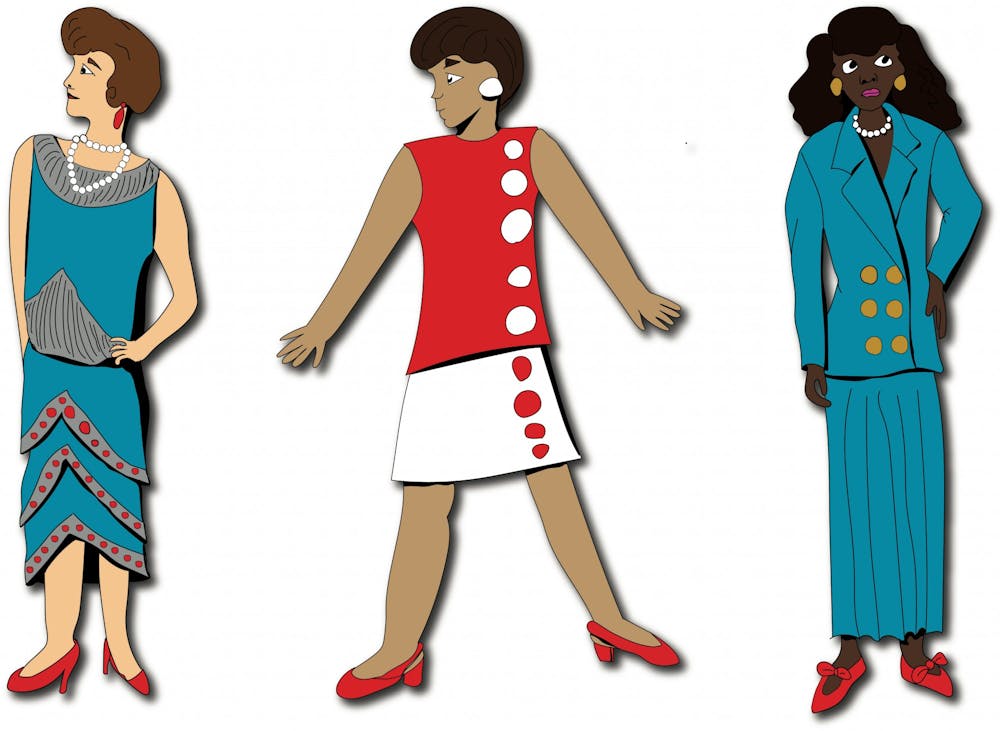 Like the rights of women, fashion is constantly evolving. Trends in the fashion industry can be indicative of the social state of women at a given time. For example, the trend of women wearing corsets in the 19th century represented the lack of freedom women had during this time; flapper dresses in the 1920s reflected the increasing freedoms of women; and housewife attire reflected the gender expectations of women in the 1950s. Fashion is often used for self-expression, but retroactively it can also be used to tell history. Art history and women's, gender and sexuality studies professor Kristin O'Rourke, who teaches COCO 1.03, "Fashion and Identity: The Power of Clothing," discussed the political implications of women's fashion in the 19th century. "If we think of 19th century clothing of the upper and middle classes, with large, cumbersome skirts, hoops and constricting corsets, women were not able to move freely, nor did they engage much in the public sphere," O'Rourke wrote in an email. "Up through WWI, women spent a significant part of their day dressing." A high beauty standard was set in the 19th century, and that has not entirely changed. American fashion remained relatively unchanged until the 1920s, when the flapper movement challenged 19th century beauty standards. With the flapper movement, women shortened both their hair and their hemlines. When the 19th Amendment was ratified and women were allowed the right to vote, many women had more of an opportunity to liberate themselves from society's expectations. At this time, the flapper movement took off and women began to engage in societally "scandalous" activities. Flappers danced to jazz music while smoking cigarettes and sipping liquor. The new lifestyle for these women called for a change in fashion. Comparative literature and women's, gender and sexuality studies professor Graziella Parati, who teaches COLT 42.01, "Prada, Chanel, Ferrari: History and Literature," commented on the effect of fashion on the changing rights of women. "When women change their condition, they change the way they dress," Parati said. In addition to shortened hemlines, women began to wear loose dresses that had dropped waistlines. Coco Chanel introduced this style of dress, which is when the "little black dress" was born. O'Rourke noted that Coco Chanel had a positive impact on women's fashion in the modern era. "She fundamentally changed the shape of women's clothing, eliminating large skirts and restrictive undergarments," O'Rourke wrote. "Her streamlined look and menswear-inspired cuts allowed women to be active and deemphasized a traditional feminine shape and style, which meant breaking the long-standing association of women with the frivolity of fashion." O'Rourke added that Chanel's design aligned with the revolutionary changes occurring for women during her time. "These changes coincided with social changes — women had recently acquired the right to vote, more young women were working and living alone in cities, more women were engaged in sports," O'Rourke said. "So, in my opinion, this really created the model for what we still have of a modern type of woman." The 1940s brought even higher hemlines and more ways for women to express their individuality. Hourglass silhouettes were now on trend, but women added "masculine" features to their wardrobes. As WWII waged on, women adopted military silhouettes and utility suits. The 1940s was the first time women could wear pants, because many women worked in the factories during the war in which pants were the safest things to work. Pants quickly escalated from workwear to casual wear for women, which increased masculine influences in women's fashion. In the 1940s, women's swimwear incorporated increasing degrees of midriff exposure as the bikini emerged. Many women deemed bikinis too revealing, but some adventurous ones wore them. According to women's, gender and sexuality studies professor Jennifer Sargent, fashion in the 1940s into the 1950s gave women more freedom in their self-expression. "We saw women wearing pants, owning what was traditionally the 'male' fashion, being able to cover their bodies or uncover their bodies in a far more unique and individual way and to be able to gender bend," Sargent said. Although the 1940s introduced more masculine influences into women's fashion, the 1950s brought in the housewife fashion trend of full skirts, cinched waists and large busts. It is important to note, however, that the top designers of women's fashion in the 1950s were men. Christian Dior is credited with creating "The New Look," which is what we know as the 1950's aesthetic. With this, Dior sent the fashion industry backward. O'Rourke commented on the implications of Dior's new design at the time. "There was, of course, a backlash in the 1950s with a return to more traditional 'values' and gender roles, exemplified by the restrictive, hyper-feminine style of Dior's 'New Look' dresses with tight waists, large skirts and high heels" O'Rourke said. Much of social change in the 1960s was dominated by feminists who fought for equal pay, ending domestic violence and sexual harassment, and ending the expectation that women would be housewives. Women in the 1960s challenged gendered fashion trends. It was then that miniskirts made their debut and boyish silhouettes came back to style. The corsets and girdles were gone, which made the 1960s "a second flapper era" as women began cutting their hair short again and even began to go braless. These women embraced 1960s' flower power and individuality. "The '60s was the first time we saw women feeling not only empowered by fashion but owning fashion for themselves and not for attracting anyone for external validation," Sargent said. "They were very much using fashion for internal validation." The 1970s also brought radical changes in fashion trends like bell bottoms and platform heels. Feminine silhouettes became more popular, but women also continued to dress in masculine attire. Furthermore, pantsuits became more popular for women in the 1970s as more and more women held professional jobs. Masculine fashion influences made a mark in the 1980s, with the use of shoulder-padded blazers as a political statement. Women wore these large blazers as a way to show power in the workplace, where men were dominant. The expectation for women to dress a certain way at work has extended to today's expectations. "Certain professions still demand a masculine form of dress," Sargent said. "The more 'conservative' the profession, the more masculine the dress for women." The 1980s and 1990s also brought opportunities for women to rebel in their fashion choices. Punk and grunge came onto the fashion scene and people began to be more and more experimental in their self-expression. Women's individuality was at a high. Women have gained more freedom over the years to express their individuality through their clothes. There is, however, still a high beauty standard for women. According to Parati, however, newer stylists have women's empowerment in mind, which is promising for the future of women's fashion. "Wearing clothes is part of how we project who we are to the world around us," Parati said. As that projection changes, women's fashion will continue to evolve.  |
| You are subscribed to email updates from "womens clothing" - Google News. To stop receiving these emails, you may unsubscribe now. | Email delivery powered by Google |
| Google, 1600 Amphitheatre Parkway, Mountain View, CA 94043, United States | |


 For women bemoaning the lack of retail options in Sandy, there is new hope for finding affordable, gently used and new clothes.
Comments
Post a Comment